FibraDisc · Non-surgical spine care · Miami & Tampa Bay
Non-surgical alternative to spinal fusion.
The FibraDisc Procedure, powered by DiscSeel technology, places fibrin sealant into torn discs through a needle — no incision, no hardware, no bone removed. Performed in Miami and Tampa Bay, with Saturday cases and bilingual care.

The FibraDisc Procedure · Miami & Tampa Bay
For the people who were told
fusion was the only option.
The FibraDisc Procedure places fibrin sealant into torn discs instead of fusing them — powered by DiscSeel technology, performed in Miami and Tampa Bay, quoted in writing before you travel, and built to fit inside a single trip.
- In writing
- Your quote, before you fly
- 48 hours
- MRI review returned
- Saturdays
- Weekend cases
- EN · ES
- Bilingual throughout
Fusion takes a season. This takes a weekend.
01Before you book
Your MRI is screened from home
A physician screens the scan you already own for candidacy and writes your quote. Nobody flies to find out.

02Friday
You land. It's handled.
Your liaison has your records, your imaging, and your schedule. Consultation the same afternoon.

03Saturday
The procedure
Annulogram, then the fibrin — through a needle, in one visit. No incision. Discharged the same day.

04Sunday
Fly home
Discharge is same-day, and the flight home is typically the next. Your follow-up plan leaves with you, in writing.

05Return visits
Follow-up, on your calendar
Repeat imaging runs on return visits — follow-up is scheduled, not a relocation.
Your dates
It starts with the scan you already have.
Request a candidacy screening
Boards, appointments & training across our physicians
- American Board of Orthopaedic Surgery
- American Osteopathic Board of Surgery
- American Academy of Orthopaedic Surgeons
- American College of Osteopathic Surgeons
- FIU College of Medicine — faculty
- Barrow Neurological Institute — fellowship
- Baptist Health Doctors Hospital
- Mercy Hospital (HCA)
- Jackson South Medical Center
A written screening of your own imaging.
Not a callback script. A physician screens the MRI you already own and says plainly whether you appear to be a candidate — including when you do not. It is a screening, not a diagnostic report or a radiologist's interpretation.
Candidacy screening
Lumbar MRI · sample report
What the MRI shows
- L5–S1Disc extrusion, annular tear suspected
- L4–L5Height loss, desiccation
- AlignmentStable — no listhesis
Where that leaves you
- 01Annulogram to confirm which levels leak
- 02FibraDisc — likely candidate, 2 levels
- 03Fusion — not indicated at this stage
Illustrative sample. An MRI can suggest a tear; only an annulogram confirms which discs actually leak.
The outer ring tears. The centre leaks.
Most back and neck pain that comes from a disc is not about the disc's shape. It is about a tear in its outer ring and what seeps out through it. Three things to know before anything on this site makes sense.
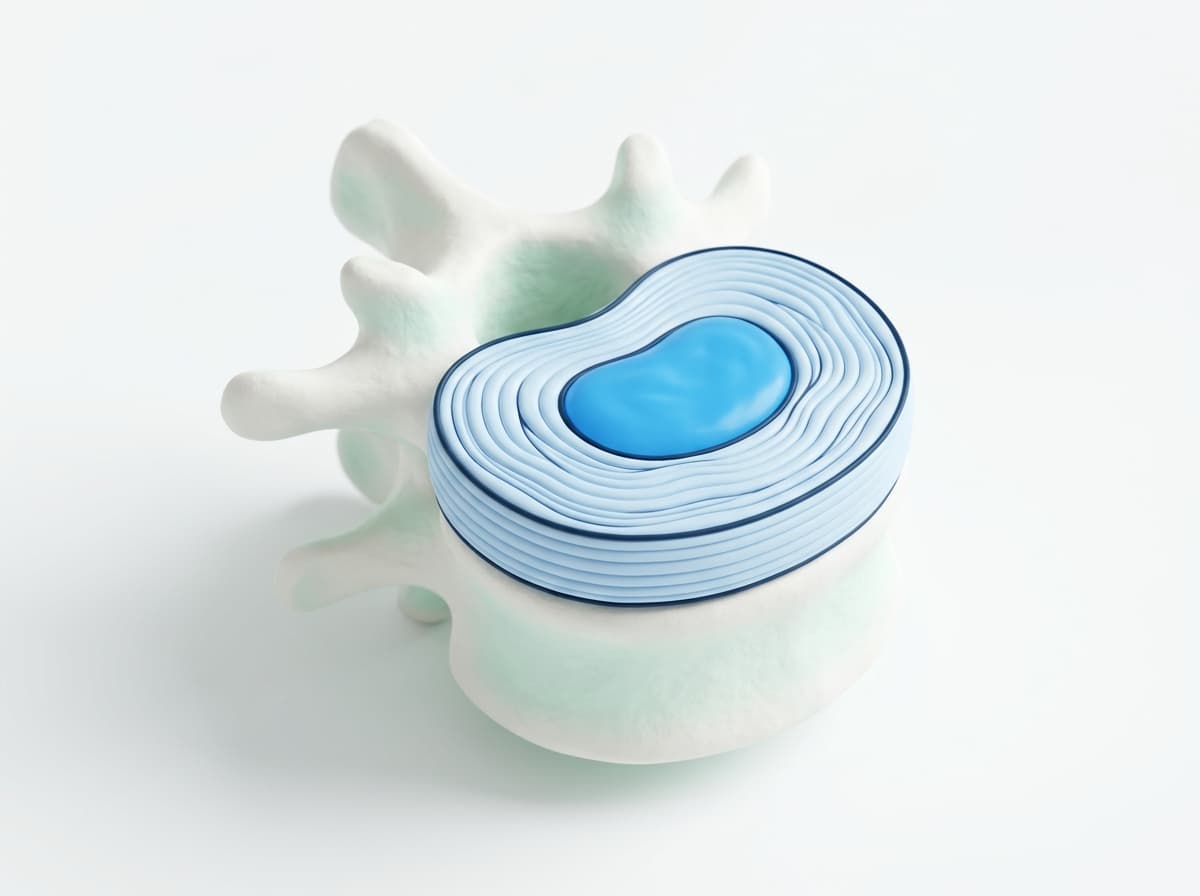
A cushion with a tough outer ring
Each spinal disc is a soft, gel-like centre held inside a ring of many thin, tough layers. The ring keeps the centre in place and carries the load every time you bend, sit, or lift.
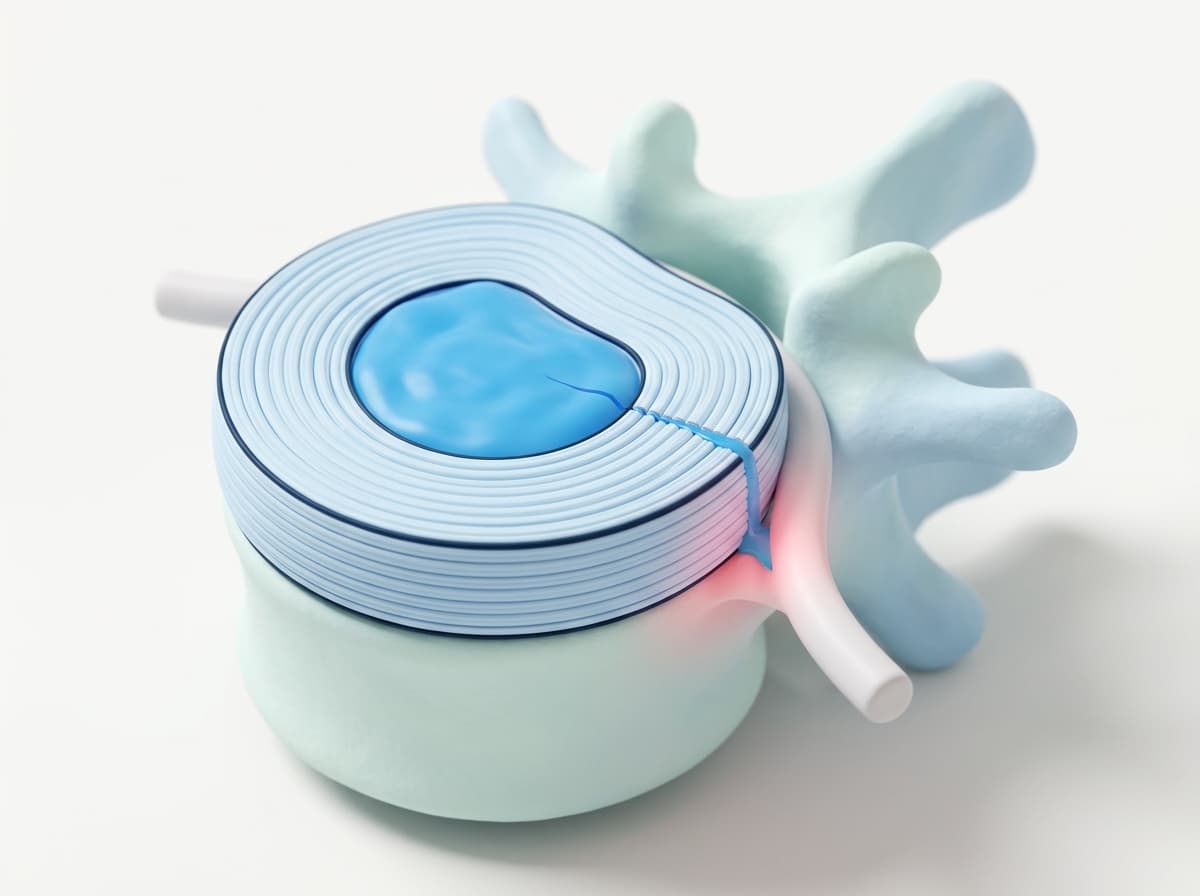
The ring can split, and the centre can leak
Wear, strain, or injury can tear the outer ring. Material from the centre seeps through the tear and can irritate the nerve root beside it — which is why a torn disc can hurt even when nothing is pressing on a nerve.
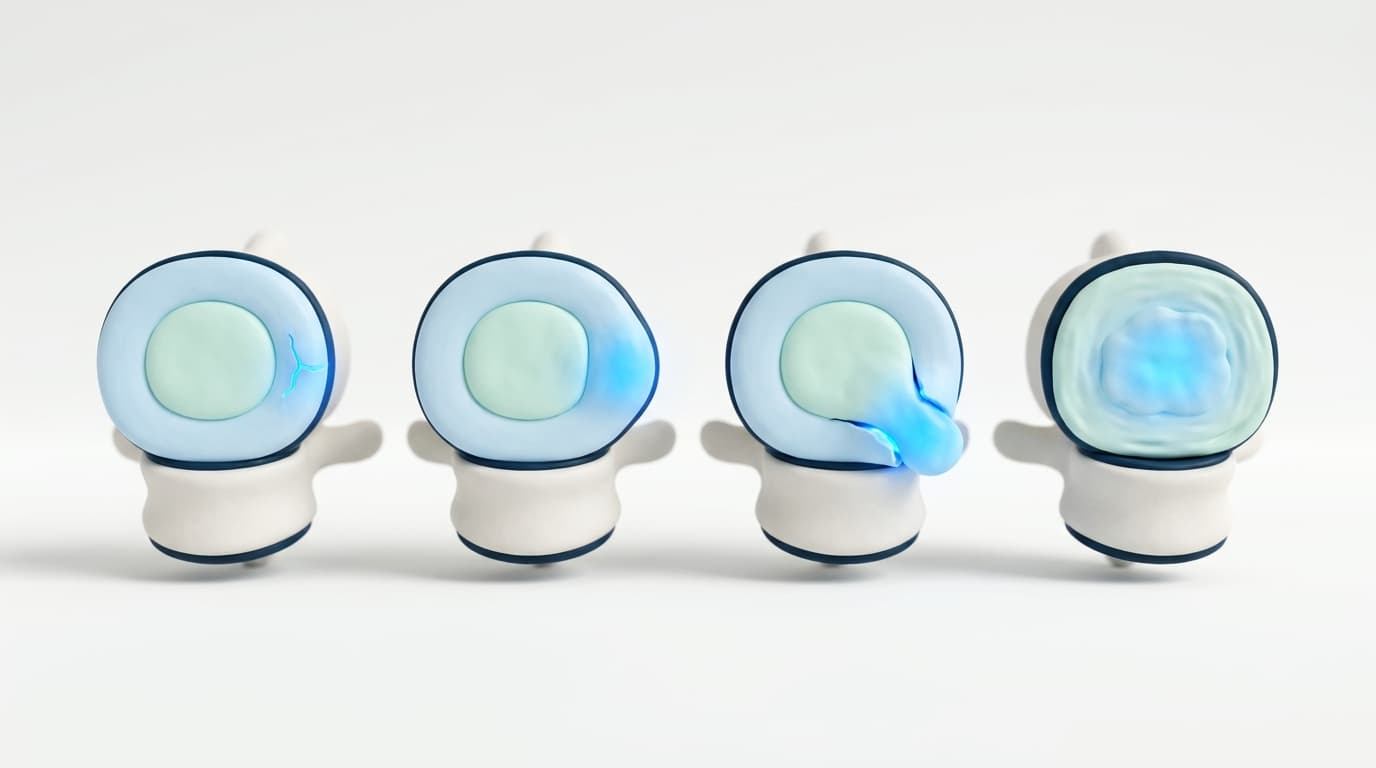
Often one problem, at different stages
A tear, a bulge, a herniation, a disc that has lost height — these are frequently the same disc at different points, not four separate conditions. That is why the useful question is not the label on your report, but whether a disc is torn and leaking.
Find the tear. Place the fibrin.
The tough outer ring of a spinal disc can split. Those tears leak, they hurt, and they do not reliably show up on an MRI. This procedure finds them with live imaging and places fibrin sealant into them — fibrin is the same clotting protein your body uses to close a wound.
Your MRI is reviewed
A physician reads the study you already have and tells you whether you look like a candidate — before you book anything.
An MRI is the entry requirement, not a formality. Without one, we can talk about the procedure in general terms but we cannot tell you anything about your spine. If you do not have a recent study, your primary care physician can order one.
An annulogram finds the tears
Contrast dye is introduced into each disc under live imaging. Torn discs leak. Intact ones do not.
This is the part an MRI cannot do. An MRI shows disc shape and height; it does not reliably show where the annulus has split. The annulogram shows the leak in real time, which is what determines which levels are treated — and sometimes shows that the disc everyone blamed is not the one that is torn.
Fibrin sealant is placed into the tears
Fibrin — a biologic sealant already used in surgery — is placed into the torn discs through a needle.
No incision, no hardware, no bone removed, and no disc taken out. Fibrin is the body's own clotting protein; in the disc it acts as a sealant and a scaffold. Because nothing structural is altered, the levels above and below are not loaded the way they are after a fusion.
You heal over months, not days
Most people are up and about the next day. The procedure is intended to support gradual healing, and the honest answer is that it takes time.
This is not a procedure that trades a long recovery for an instant result. You walk out the same day and resume ordinary activity quickly, but any healing that follows is measured in months, varies between individuals, and is not guaranteed. Anyone who promises you a switch being flipped is selling you something.
What each option actually does to your spine.
No outcome claims in this table — only what is removed, what is left behind, and what remains possible afterwards.
Incision
- FibraDisc
- None — needle only
- Fusion
- Open or minimally invasive incision
- Artificial disc
- Open incision
Hardware left in the body
- FibraDisc
- None
- Fusion
- Screws, rods, cages
- Artificial disc
- Prosthetic disc
Bone removed
- FibraDisc
- None
- Fusion
- Yes
- Artificial disc
- Yes
Your own disc
- FibraDisc
- Kept
- Fusion
- Removed and fused
- Artificial disc
- Removed and replaced
Adjacent levels
- FibraDisc
- Not surgically loaded
- Fusion
- Load transferred to neighbouring discs
- Artificial disc
- Motion preserved at the treated level
Surgery still possible afterwards
- FibraDisc
- Yes
- Fusion
- Revision only
- Artificial disc
- Revision only
Setting
- FibraDisc
- Outpatient, same day
- Fusion
- Hospital, often overnight
- Artificial disc
- Hospital, often overnight
Typically covered by insurance
- FibraDisc
- No — self-pay
- Fusion
- Usually
- Artificial disc
- Usually
Start with the tear, not the diagnosis.
Most people arrive with a diagnosis drawn from an MRI report. An MRI shows disc shape and height — it does not reliably show where the annulus has split. Finding the actual tear is what decides whether this procedure can help you.
It is not right for everyone. We will say so.
Often a good fit
- Chronic low back or neck pain that has not resolved with conservative care
- A recent MRI showing disc degeneration, bulging, or herniation
- Pain after a failed spine surgery, including fusion
- You have been told fusion is the next step and want another option first
- You want to avoid hardware and preserve your own disc
Not a fit, or not yet
- No recent MRI — we cannot assess you without imaging
- Progressive weakness, foot drop, or loss of bladder or bowel control (seek care now)
- Active spinal infection or cancer involving the spine
- Severe spinal instability or high-grade slippage
- Expecting insurance to cover it — the procedure is self-pay
A fusion costs you a season. This costs you a weekend.
Everything here is logistics, not medicine — the practical shape of coming to Miami, from the candidacy screening you get before you book a flight to the follow-up that happens on a return visit.
- Outpatient, through a needle
- Nothing implanted
- Nothing removed
- Fly home the next day
Same spine. Different week.
Why people fly past closer clinics.
Board-certified physicians, a written quote before you travel, Saturday cases, and one person handling your whole trip — the practical case for coming to Florida.
Treatment starts with an annulogram, not a guess.
Every other practice offering this procedure learned it from us. When something unusual shows up on your annulogram, there is no one further up the chain to call.
Your quote is in writing, and it holds
Your total is quoted in writing after candidacy screening, before you book a flight — not discovered on a call. The number in your written quote is the number you pay.
Saturday appointments
Procedures and consultations run on Saturdays. Fly in Friday, be seen Saturday, fly home Sunday — treatment costs you a weekend, not a week of work or a second trip.
Bilingual staff, start to finish
Consultation, consent, procedure, and follow-up in English or Spanish — with the same person, not a phone interpreter passed between departments.
A patient liaison who stays with you
One named person handles your scheduling, your imaging, your records, and your travel into Florida. You are not calling a main line and explaining yourself again.
One procedure. With or without travel.
This procedure is self-pay and covers one disc. Book it on its own, or with the trip arranged and paid as part of the package. If the annulogram shows more than one disc leaking, additional discs are added per disc, and your quote follows in writing after candidacy screening.
Procedure
One disc. Travel not included.
Best for: A single torn disc confirmed on the annulogram, for people who would rather book their own flights and hotel.
- FibraDisc procedure — one disc
- Annulogram to confirm which disc leaks
- Imaging review and candidacy assessment
- Post-procedure follow-up
- You arrange your own travel
Procedure + Travel
One disc. Travel covered.
Best for: The same single-disc procedure, with the trip arranged and paid as part of the package.
- Everything in the Procedure package
- Round-trip airfare to Miami or Tampa Bay
- Hotel stay for the procedure window
- One liaison handling the whole trip
- Scheduling around your flight, including Saturdays
Add-ons and ongoing care
Quoted separately in writing, added only if you want them.
- Additional discs Same visit
- Both packages cover one disc. If the annulogram shows more than one disc leaking, each additional disc is treated in the same visit and quoted per disc, with or without travel.
- MRI upgrade Before treatment
- A higher-resolution study than the one you arrive with, where the existing scan is not detailed enough to plan from.
- Follow-up MRI After treatment
- Repeat imaging so you can see what changed rather than relying on how you feel on the day.
- Post-op mesenchymal exosome IV therapy After treatment
- An intravenous flush of 100 billion mesenchymal exosomes derived from Wharton's jelly stem cells, sourced from a healthy full-term pregnancy and manufactured under current Good Manufacturing Practice (cGMP) in an ISO 5 facility in the United States.
Prefer to pay monthly?
Your liaison will work with you on third-party financing options — such as CareCredit, Klarna, or Affirm — so treatment can be paid over time. Your written quote is the same number either way.
Board-certified. Fellowship-trained. In the room with you.
An orthopaedic spine surgeon and a neurosurgeon — the physician who reads your imaging is the physician who treats you, not a name on a door.
47
Publications, chapters, abstracts & posters across the team

Douglas A. Hollern, MD, FAAOS
Orthopaedic Spine SurgeonCervical & lumbar spine — disc preservation, Miami
American Board of Orthopaedic Surgery — certified 2024
Spine Surgery / AO Fellowship — University of Southern California · 2021–22
Orthopaedic Surgery Residency — SUNY Downstate / Kings County Hospital · 2016–21
Spine Research Fellowship — Jefferson University / Rothman Institute · 2015–16
Assistant Professor of Orthopaedic & Spine Surgery, FIU College of Medicine
Attending privileges at Mercy (HCA), Baptist Health Doctors Hospital, Jackson South, and Larkin — all in Miami
24 peer-reviewed publications and 8 textbook chapters on spine surgery
United States Marine Corps, 2003–2007
24 peer-reviewed papers, plus 8 book chapters
Full profile
Kyle Oaks Colle, DO, FACOS
NeurosurgeonNeurosurgical spine — minimally invasive techniques
Board-certified, American Osteopathic Board of Surgery — Neurological Surgery
Fellow, American College of Osteopathic Surgeons — 2014
Neurosurgical Spine Fellowship — Barrow Neurological Institute · 2007–08
Chief Resident, Neurosurgery — North Shore–Long Island Jewish Health System · 2004–07
Neurosurgical Residency — Barrow Neurological Institute · 2002–04
Partner–President, Regional Brain & Spine, 2007–2021
Published on minimally invasive lumbar fusion and cervical disc-prosthesis biomechanics
U.S. Army flight surgeon — 17th Aviation Brigade, Korea; Ft. Benning, 1997–2001
15 papers, abstracts & posters
Full profileThe things people ask before they call.
It is a non-surgical treatment for torn spinal discs. Under live imaging, a physician first performs an annulogram to find which discs are actually leaking, then places fibrin — a biologic sealant already used in surgery — into those discs through a needle. There is no incision, no hardware, and no bone removed.
Find out if you are a candidate.
Eight short questions. A physician reviews your answers alongside the MRI you already have, and the intake team calls you back with a straight answer and a total price.
- The candidacy screening costs nothing and commits you to nothing.
- A written screening result — not a diagnostic report.
- Self-pay pricing quoted in full, in writing, up front.
Rather just talk?
(833) 719-6978Step 1 of 8Area
about 2 min left
The screening is an initial candidacy assessment, not a diagnostic report and not a substitute for a radiologist’s interpretation. It does not establish a physician–patient relationship; candidacy is confirmed only after an in-person evaluation.